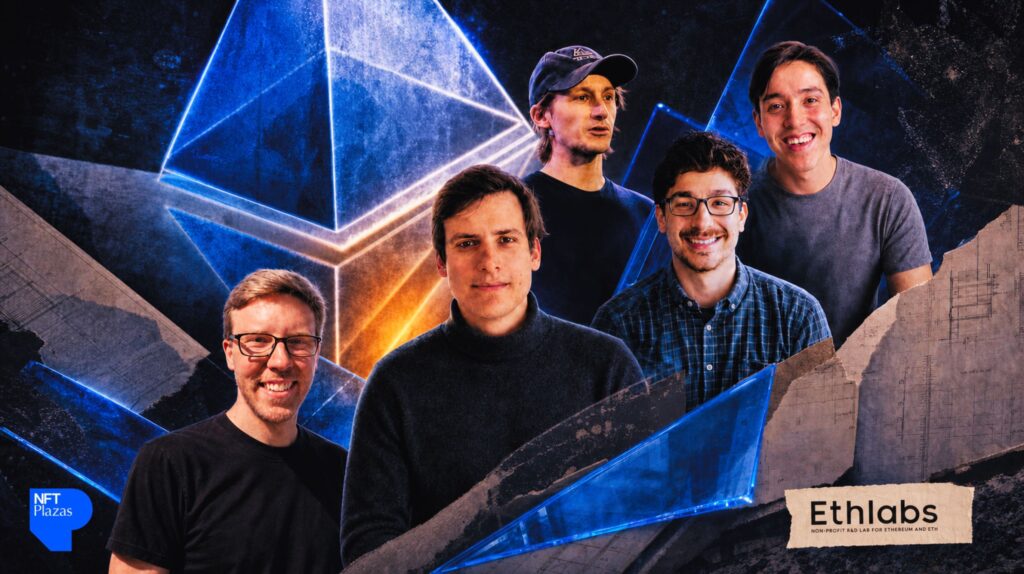

Five former senior researchers from the Ethereum Foundation have launched Ethlabs, an independent non-profit R&D organization dedicated to advancing Ethereum’s technical capabilities for the mass adoption phase. Ethlabs launched on June 22nd with backing from BitMine, SharpLink, and Ethereum co-founder Joe Lubin.
The emergence of Ethlabs comes during the same week the Ethereum Foundation announced a restructuring and team downsizing. This move places Ethlabs within a broader shift, where protocol research and development is seeing independent organizations assume larger roles outside the Foundation.
What Is Ethlabs?
Ethlabs was co-founded by Ansgar Dietrichs, Barnabé Monnot, Caspar Schwarz-Schilling, Josh Rudolf, and Julian Ma — five senior researchers who formerly worked at the Ethereum Foundation. The team has extensive experience in finality, scaling, data availability, the Ethereum Virtual Machine, and protocol economics.
Announcing Ethlabs: a non-profit R&D lab for Ethereum and ETH
Our mission is to make Ethereum the settlement layer of the global economy.
The internet became global because shared protocols created a common language between networks. Private systems remained useful, but…
— Ethlabs (@ethlabs_org) June 22, 2026
Ethlabs has not announced a technical roadmap with deadlines. However, the organization stated that its initial work will focus on faster settlement, native issuance, cross-chain infrastructure, expanding mainnet capacity, and foundational research into the monetary properties of ETH.
In the thesis, Ethlabs describes itself as a bridge between real-world adoption needs and protocol development. The Lab stated it will work with builders, wallets, Layer 2s, infrastructure teams, financial institutions, core developers, and ETH holders, and then translate common requirements into work at the protocol, standards, infrastructure, or product level.
BitMine, SharpLink, and Joe Lubin are categorized by Ethlabs as anchor funders; SNZ, Octant, and Konstantin Lomashuk belong to the contributor group. The remaining names on the list are community supporters. Distinguishing between these three groups helps prevent mischaracterizing every supporter as a funder or commercial partner of Ethlabs.
A New Node in Ethereum’s R&D Network
Ethlabs calls this approach a “multi-node future.” According to the organization, Ethereum is a shared project and Ethlabs is merely an independent node in a network of teams jointly researching, developing, and defending the protocol — not a new center of power.
This positioning aligns with Ethereum’s inherently decentralized structure, where client teams, Layer 2s, independent research groups, the Protocol Guild, grant-giving organizations, and the open-source community all play distinct roles. Ethlabs aims to complement that network by channeling demands from builders, users, and institutions into technical work at the protocol level.
Ethlabs stated that its research direction will be determined by the organization’s leadership. According to the published mechanism, funding will be handled through an independent grants administrator; funders will receive transparent quarterly reports and an annual audit, instead of having decision-making power over the technical agenda.
Ethereum Foundation’s Restructuring Sets the Context
On the same day Ethlabs announced its launch, the Ethereum Foundation stated it had completed a multi-month restructuring process. According to the Foundation’s announcement, 54 personnel — representing approximately 20% of the workforce — left the organization. The Foundation was also reorganized into clusters focused on protocol, access, user, community, and institutional, alongside operations and management departments.
Today, the EF is changing shape, concluding a months-long process of reorganization as part of the implementation of the Mandate and the Treasury Management Policy.
We come out of this process with the structure, activities, and people necessary for execution on the critical…
— Ethereum Foundation (@ethereumfndn) June 23, 2026
The Foundation noted that many individuals leaving the organization may continue to contribute to Ethereum from the outside. This places Ethlabs in a broader context, where former personnel and independent groups can take on larger roles in the ecosystem without being part of the Foundation’s direct structure.
Nevertheless, the two sides emphasize different priorities. The Foundation describes the Protocol Layer as the department tasked with defending censorship resistance, privacy, security, open source, and resistance to capture. According to the Foundation, this mission is not intended to make Ethereum more marketable, serve short-term interests, or turn the network into a financial rail controlled by intermediaries. Meanwhile, Ethlabs emphasizes the needs of institutions, DeFi, and agentic commerce. While this is not yet a contradiction, it presents a practical test: how far Ethereum can scale for institutions while still retaining its core properties.
Why Institutional Demand Matters Now
Priorities regarding settlement, interoperability, and mainnet capacity have clear technical foundations. Ethereum currently takes about 15 minutes for a block to achieve finality — a state that is virtually economically irreversible. The Foundation stated that the goal of single-slot finality could significantly shorten this timeframe, but it comes with trade-offs between speed, validator operating costs, and decentralization.
The scale of on-chain assets also helps explain why these issues are gaining attention. According to data from RWA.xyz, Ethereum currently commands $16.09 billion in distributed RWA value, 201,277 RWA holders, and a $159.16 billion stablecoin market cap. While these figures do not prove that an “institutional supercycle” has occurred, they demonstrate that Ethereum is handling a large enough volume of assets for settlement speed, mainnet capacity, and cross-chain infrastructure to become strategic issues.

Ethereum RWA and stablecoin metrics. Source: RWA.xyz
Ethlabs has not indicated whether they will directly develop single-slot finality or a specific EIP. Faster settlement is currently the direction announced by the organization, while improving finality remains a technical path within the broader Ethereum roadmap.
The Independence Test
Ethlabs is backed by organizations holding large amounts of ETH, making the mechanism that separates funding from the research agenda a key point to watch.
According to updates published in early May, BitMine held 5.18 million ETH, equivalent to 4,29% of the supply, as of May 3rd; SharpLink recorded 872,984 ETH as of May 4th. These figures show that the two corporate treasuries have a strong incentive to support Ethereum’s technical capabilities and adoption, while making Ethlabs’ governance a matter for closer observation.
Ethlabs stated that funders do not have the power to decide research priorities. The organization has not yet disclosed the size of its funding, the composition of its board, the process for handling conflicts of interest, or the identity of the grants administrator. These disclosures, along with the first reports and audits, will show the extent to which the separation of funding from the research agenda is being achieved.
What Comes Next for Ethlabs and Ethereum
In the short term, the signs worth watching are public research, open-source software, contributions to EIPs or client teams, along with technical goals that have specific scopes and deadlines. This will be the clearest metric for how Ethlabs translates its orientation into work that can be evaluated and utilized by the Ethereum community.
Ethlabs will not change Ethereum’s roadmap on its own. But the launch of this lab is a new test for the network’s multi-organization R&D model: whether independent groups can complement Ethereum’s technical capabilities while maintaining the protocol’s openness and neutrality.
The post Former Ethereum Foundation Contributors Launch Ethlabs R&D Nonprofit appeared first on NFT Plazas.
Source: https://nftplazas.com/former-ethereum-foundation-contributors-launch-ethlabs-rd-nonprofit/
