What is Fabric Protocol (ROBO)? This question helps explain a project that is drawing attention in the decentralized network space. You get to understand how Fabric Protocol combines robotics, blockchain, and verifiable automation in a practical way. As you read on, you’ll see what the ROBO token does, why the project stands out, and what it may mean for investors looking ahead to 2026.
In this article, we’ll break down how Fabric Protocol works, what gives the ROBO token value, and what its 2026 price outlook could look like. We’ll also help you decide whether this project is worth following more closely. Keep reading.
What Is Fabric Protocol (ROBO)?
Fabric Protocol (ROBO) is a blockchain project that links robots, autonomous systems, and on-chain coordination in one framework. It gives machines a way to register identity, receive tasks, verify completed work, and interact with smart contracts without relying on a single central operator. If you’re looking for a clear example while learning how blockchain works in real-world applications, Fabric Protocol shows how the technology can move beyond finance and support real machine activity.
The project is also tied to the fabric foundation, which supports the broader vision behind the protocol and its long-term development. In simple terms, Fabric Protocol aims to make robotic work more transparent, trackable, and easier to validate on-chain. That gives ROBO a role within a system where machines, data, and incentives work together under clear rules.
What Problems Does Fabric Protocol Solve?
Fabric Protocol addresses several challenges within the robot economy, creating a more efficient and collaborative system. Here are five key problems it solves:
- Lack of Coordination: Robots often operate in isolation, leading to inefficiencies. Fabric Protocol enables seamless collaboration through a decentralized framework.
- Data Integrity Issues: Ensuring the accuracy and security of data shared between robots is critical. The protocol uses blockchain to maintain a reliable record of interactions.
- Task Allocation Challenges: Assigning tasks to the right robots can be complex. Fabric Protocol simplifies this by using decentralized task allocation mechanisms.
- Accountability in Robotic Work: Verifying completed tasks can be difficult. The protocol introduces Proof of Robotic Work (PoRW) to ensure accountability.
- Limited Scalability: Traditional systems struggle to scale as the robot economy grows. Fabric Protocol provides a scalable solution for managing large networks of robots.
Who Is Behind Fabric Protocol?
The Fabric Protocol was created by OpenMind. This is a team dedicated to advancing robotics and blockchain integration. They introduced the OM1 OS, an open-source operating system that serves as a universal platform for robots. This foundation laid the groundwork for the Fabric Protocol, enabling seamless collaboration within the robot ecosystem.OpenMind has implemented a transparent token distribution model to support the protocol’s operations and incentivize participation within the network. This ensures that resources are allocated effectively, fostering growth in the robot economy.
How Does Fabric Protocol Work?
Fabric Protocol functions as a decentralized network, allowing robots to operate as independent governance participants in the robot economy. It provides the infrastructure needed for robots to interact, collaborate, and complete tasks autonomously. Below are its main components:
Robot Identity & On-Chain Registry
Fabric Protocol assigns each robot a unique machine identity that is recorded on the blockchain. This identity allows robots to securely participate in the network, interact with other entities, and maintain a transparent record of their activities.
Decentralized Task Allocation
The protocol uses smart contracts to allocate tasks across the network. Robots can bid for tasks based on their capabilities, creating an efficient system where work is distributed without relying on a central authority.
Proof of Robotic Work (PoRW)
PoRW is a mechanism that validates tasks completed by robots. This system records completed work on the blockchain and rewards robots for their contributions, creating a transparent and accountable process.
Verifiable Compute & Smart Contracts
Fabric Protocol leverages smart contracts to enable robots to execute tasks and exchange data securely. Verifiable compute ensures that all operations are transparent and tamper-proof, making it an ideal AI crypto investment.
Key Features of Fabric Protocol
Fabric Protocol introduces a range of features that redefine how robots interact and operate within a decentralized network. These capabilities are designed to support the growth of the robot economy and enhance collaboration across the system:
- Decentralized Network for Robots. Fabric Protocol creates a global, decentralized network where robots can operate autonomously, interact with other entities, and participate in economic activities without centralized control.
- On-Chain Identity System. Each robot is assigned a unique, verifiable identity stored on the blockchain. This identity allows robots to securely interact, maintain transparency, and build trust within the network.
- Autonomous Task Allocation. The protocol uses smart contracts to facilitate task allocation. Robots can bid for tasks based on their capabilities, promoting efficient work distribution and reducing operational bottlenecks.
- Proof of Robotic Work (PoRW). This feature validates and records completed tasks on the blockchain. Robots are rewarded for their contributions, creating a transparent and accountable system for task execution.
- Scalability for the Robot Economy. Fabric Protocol is designed to support a growing network of robots, making it adaptable to the increasing demands of the robot economy.
- ROBO Token Integration. The native ROBO token is used for transaction fees, staking, governance, and rewarding robotic work, creating a self-sustaining economic model.
What Is the ROBO Token?
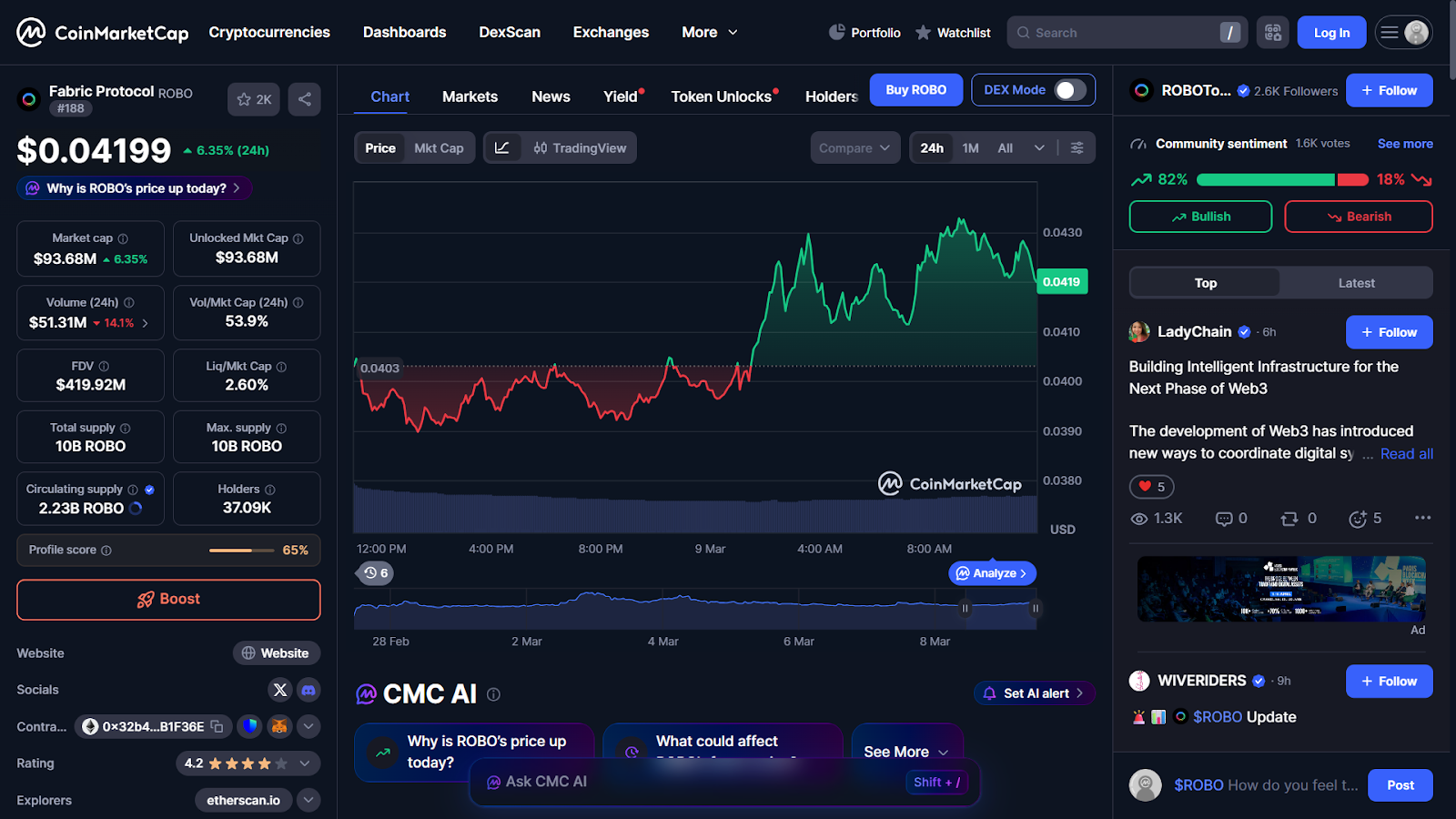
The ROBO token is the native utility asset of the Fabric Protocol, designed to power the decentralized network and support the robot economy. It plays a central role in facilitating transactions, incentivizing participation, and enabling governance within the fabric ecosystem. Here is the working mechanism:
ROBO Tokenomics & Supply
The ROBO token has a fixed total supply of 10 billion, ensuring long-term stability and value alignment. Its tokenomics are structured to support various network operations:
- Fees: The token is used to pay for transaction fees, such as identity verification and data provision exchange within the network.
- Staking: Robot operators can stake ROBO tokens as work bonds, which act as a commitment to perform tasks reliably.
- Governance: Token holders can participate in decentralized governance by voting on protocol updates and decisions.
- Payments: ROBO tokens facilitate payments for services and task settlements within the network.
Functions of the ROBO Token
- Transaction Fees: Used to cover costs for blockchain operations, including identity registration and task execution.
- Staking for Work Bonds: Operators stake tokens to demonstrate reliability and gain access to task opportunities.
- Governance Participation: Token holders influence the protocol’s future by voting on proposals and updates.
- Incentives for Robotic Work: Rewards are distributed to robots for completing verified tasks through the Proof of Robotic Work mechanism.
- Task Settlements: Acts as a medium of exchange for payments between robots and users.
ROBO Real-World Use Cases
- Autonomous Delivery Services: Robots use ROBO tokens to bid for delivery tasks and receive payments upon completion.
- Industrial Automation: Factories can allocate tasks to robots and settle payments using the token.
- Smart City Operations: Robots in smart cities can coordinate tasks like waste management or surveillance, with payments facilitated by ROBO tokens.
- Decentralized Marketplaces: Robots can participate in marketplaces to offer services or purchase resources using the token.
- Research and Development: Developers can use ROBO tokens to access network resources and test new robotic applications.
ROBO vs. Ethereum
| Feature | ROBO (Fabric Protocol) | Ethereum |
| Primary Purpose | Focused on the global robot economy, enabling robots to act as independent economic agents. | General-purpose blockchain for decentralized applications and smart contracts. |
| Consensus Mechanism | Proof of Robotic Work (PoRW) validates robotic tasks and contributions. | Proof of Stake (PoS) secures the network and validates transactions. |
| Native Token | ROBO token, used for fees, staking, governance, and task payments. | ETH, used for transaction fees, staking, and executing smart contracts. |
| Target Users | Robots, robot operators, and industries utilizing robotics. | Developers, businesses, and users building or interacting with dApps. |
| Task Allocation | Decentralized task allocation specifically built for robotic operations. | General-purpose smart contracts for a wide range of use cases. |
| Identity System | On-chain identity registry provides unique identities for robots. | No native identity system and relies on third-party solutions. |
| Scalability | Plans to transition to a dedicated Layer 1 blockchain optimized for machine operations. | Uses Layer 2 solutions like Optimism and Arbitrum to improve scalability. |
| Governance | Decentralized governance through token holder voting with veROBO. | Governance through Ethereum Improvement Proposals (EIPs) and community consensus. |
| Use Cases | Autonomous delivery, industrial automation, smart cities, and robotic R&D. | DeFi, NFTs, gaming, supply chain, and general-purpose decentralized apps. |
| Transaction Fees | Lower fees tailored for robotic operations and task settlements. | Variable gas fees based on network congestion and demand. |
| Interoperability | Initially deployed on Ethereum Layer 2, with plans for its own Layer 1 blockchain. | Interoperable with multiple blockchains through bridges and Layer 2 solutions. |
Fabric Protocol (ROBO) Price Prediction for 2026
The price of Fabric Protocol (ROBO) is influenced by several factors, including market conditions, adoption rates, and technological advancements. Below is an analysis of its potential price trajectory:
Expected Price Range
Under stable market conditions, ROBO is projected to trade within the $0.03 – $0.06 range.
During bullish cycles, with increased adoption in the robotics and blockchain sectors, the price could rise toward the $0.08 level.
Key Drivers of Price Movement
- Market Sentiment: The overall sentiment in the cryptocurrency market, including liquidity inflows and trading volume, plays a significant role in short-term price fluctuations.
- Adoption and Use Cases: Increased participation in the Fabric Protocol ecosystem, such as task settlements and governance, can drive demand for the ROBO token.
- Technological Development: Advancements in the protocol, including its transition to a dedicated Layer 1 blockchain, may boost investor confidence and long-term value.
Future Growth Prospects
If Fabric Protocol continues to expand its role in the robotics and decentralized infrastructure industries, its value could see sustained growth. The integration of robotics with blockchain technology positions ROBO as a unique asset in the market, with potential for significant appreciation as adoption increases.
Is Fabric Protocol (ROBO) a Good Investment?
Fabric Protocol (ROBO) stands out as one of the best AI crypto projects, combining blockchain technology with robotics to create a decentralized network for autonomous AI agents. By anchoring robot identity, task coordination, and incentives on-chain, it addresses critical gaps in the robotics industry. This unique focus positions ROBO as a forward-thinking solution in the evolving AI and blockchain landscape, making it an attractive option for investors seeking innovative projects.
The protocol’s token distribution model emphasizes long-term alignment and sustainable growth. With a market cap of 1.60B and a fixed supply of 10 billion tokens, ROBO is designed to support fabric network fees, staking, and governance. This structure not only incentivizes participation but also ensures that the token remains integral to the ecosystem’s operations. As adoption grows, the demand for ROBO tokens is expected to increase, further enhancing its value proposition.
For those interested in the future of robotics and AI, Fabric Protocol offers a compelling investment opportunity. Its focus on autonomous AI agents and decentralized coordination creates a robust foundation for growth. However, like any investment, it carries risks, including market volatility and regulatory challenges. Investors should carefully evaluate their risk tolerance and conduct thorough own research before committing to ROBO.
How to Buy Fabric Protocol (ROBO)
The process of buying crypto, including Fabric Protocol (ROBO), is straightforward and can be completed in a few simple steps:
- Create a Crypto Wallet. Start by setting up a secure crypto wallet. Choose a wallet that supports ROBO and offers features like self-custody and security tools.
- Deposit Funds into Your Wallet. Add funds to your wallet by transferring cryptocurrency from another wallet or purchasing crypto directly using a credit or debit card.
- Find a Supported Exchange. Locate a cryptocurrency exchange that lists Fabric Protocol (ROBO). Popular exchanges often provide trading pairs like ROBO/USDT or ROBO/ETH.
- Search for ROBO.Use the search bar on the exchange platform to find Fabric Protocol (ROBO). Select the appropriate trading pair to proceed.
- Place a Buy Order. Enter the amount of ROBO you want to purchase. Review the details carefully and confirm your order.
- Store Your ROBO Securely. After purchasing, transfer your ROBO tokens to your wallet for safekeeping. Avoid leaving them on the exchange to reduce security risks.
- Monitor Your Investment. Keep track of your ROBO holdings and stay updated on crypto market trends and project developments to make informed decisions.
The Future of Fabric Protocol
The future of Fabric Protocol is centered on its ability to revolutionize the robotics industry by integrating blockchain technology. As a decentralized network, it aims to establish a global ecosystem where robots function as autonomous economic agents, driving efficiency and innovation.
Key developments, such as the transition to a dedicated Layer 1 blockchain, will enhance scalability and optimize operations for machine-native tasks. This evolution positions Fabric Protocol as a leader in the robotics and blockchain sectors, with the potential to attract widespread adoption.
With its focus on verifiable contributions, governance, and task coordination, Fabric Protocol is poised to play a pivotal role in shaping the future of robotics infrastructure. As adoption grows, it could redefine how robots interact, collaborate, and contribute to the global economy.
Conclusion
Fabric Protocol represents a groundbreaking step in merging robotics with blockchain technology, offering a decentralized framework for autonomous operations and verifiable contributions. With its focus on scalability, governance, and real-world applications, it has the potential to transform the robotics industry and drive innovation in decentralized infrastructure. While its future depends on adoption and technological advancements, Fabric Protocol is well-positioned to become a key player in the evolving AI and blockchain landscape.
FAQs
You can buy ROBO tokens on supported cryptocurrency exchanges that list Fabric Protocol, such as those offering ROBO/USDT or ROBO/ETH trading pairs.
Fabric Protocol currently operates on Base (EVM-compatible) and plans to transition to its own dedicated Layer 1 blockchain.
The “Proof of Units” mechanism validates and records robotic contributions on-chain, ensuring transparency and rewarding verified work.
Yes, ROBO is available for spot trading on major exchanges, providing liquidity and accessibility for investors.
