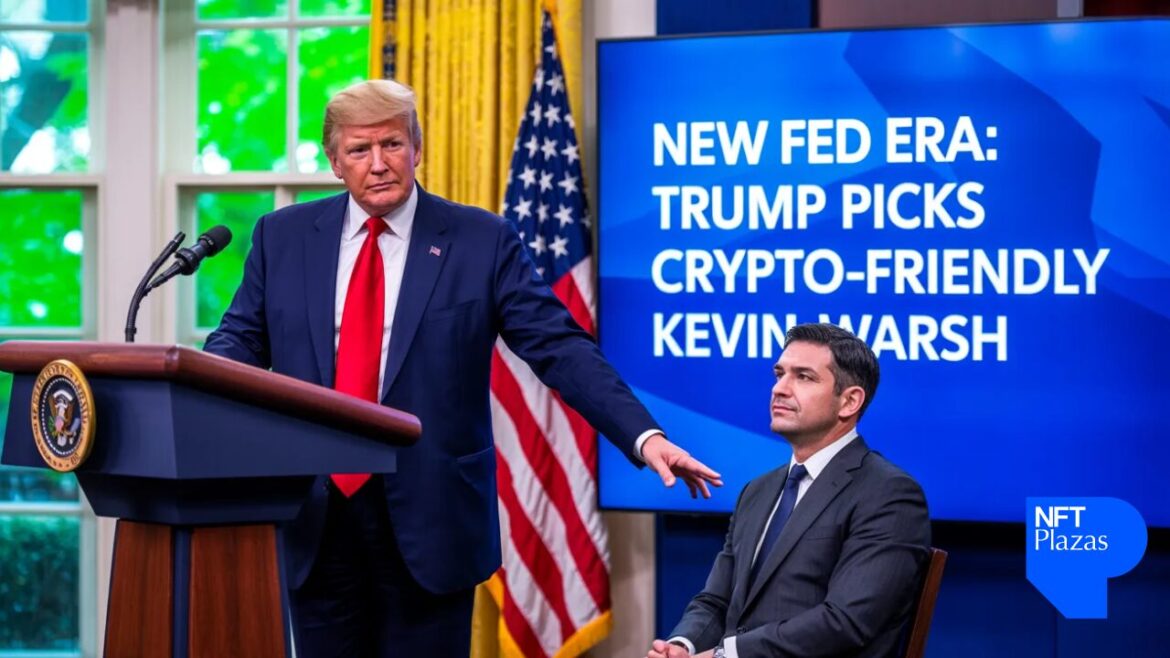
On January 30, 2026, president Donald Trump officially nominated Kevin Warsh to lead the Federal Reserve, effectively ending the Jerome Powell era. Speculation regarding this seat reached a fever pitch over the last month, yet the final choice still managed to rattle major asset classes. Trump hailed Warsh as “perfect” and “great” on Truth Social, signaling a desire for a radical shift in monetary philosophy.
Kevin Warsh’s Professional History
Kevin Warsh has extensive experience in the marble halls of the Eccles Building. At age 35, he became the youngest Governor in the history of the Federal Reserve. He served from 2006 to 2011, placing him in the “war room” during the 2008 Global Financial Crisis. Unlike traditional central bankers, Warsh lacks a PhD in Economics. Instead, he holds a JD from Harvard Law, mirroring the professional background of Jerome Powell.
Learn more: Crypto Trading Strategies – NFTPlazas Reasearch
Wall Street veterans remember Warsh as the “markets guy.” During the 2008 collapse, he acted as the primary liaison between the Fed and the banking giants. Former Chair Ben Bernanke once called him his “closest confidant.” His experience at Morgan Stanley gave him a pragmatic edge that academic economists often lack. Since leaving the Fed, he has taught at Stanford and worked at the Hoover Institution, cementing his status as a titan of conservative economic thought.

Trump announced Kevin Warsh as new Fed chair on Truth Social. – Source: Truth Social
His Policy Pivot
Historically, markets labeled Warsh an “inflation hawk.” In 2008, he famously warned that aggressive rate cuts might trigger long-term price spikes. He even voted against the Fed’s second round of quantitative easing (QE2) in 2011 before resigning his post. However, the 2026 version of Kevin Warsh appears more pragmatic. He recently shifted his tone, aligning more closely with Trump’s desire for lower interest rates.
Warsh now champions a “stronger, not hotter” economic thesis. Warsh argues that artificial intelligence (AI) has triggered a massive surge in productivity. In his view, these technological gains allow the Fed to cut interest rates without fueling inflation. He believes the U.S. economy can grow faster than traditional models suggest. By leaning into this AI optimism, Warsh provides the intellectual architecture for the “dovish” turn that the White House demands.
Political Friction
Despite the excitement from the White House, Kevin Warsh faces significant challenges, the most immediate being a difficult Senate confirmation process.
Lawmakers from across the political spectrum expressed immediate concerns regarding the Fed’s future independence under a Trump-aligned chair. Specifically, Senator Elizabeth Warren accused Warsh of tailoring his economic views to satisfy the White House’s short-term political demands. Conversely, Republican critics worry that his “hawkish” roots might eventually lead to tighter policy than the President expects.

Source: Bloomberg
Markets Immediately React
Financial markets reacted immediately to the nomination news. The U.S. Dollar Index (DXY) strengthened as traders anticipated a more disciplined approach to the Fed’s balance sheet.
Conversely, safe-haven assets took a massive hit. Gold prices plunged over 6% in a single day, falling toward the $5,050 per ounce mark. Investors interpret Warsh’s arrival as a move toward “hard money” rhetoric, even if the actual rates remain low. Stock futures also registered “knee-jerk disappointment,” with major indices slipping about 0.5%. Meanwhile, Bitcoin experienced a similar dip, sliding toward $81,000 as the “cheap money” narrative cooled.
New Ally of Crypto Investors
Cryptocurrency investors view Warsh as a revolutionary figure for the digital age. Unlike Powell, who often downplayed digital assets, Warsh views Bitcoin as a “sustainable store of value.” He has previously described cryptocurrency as a “policeman” for central bank policy. In his view, when central banks debase fiat currencies, Bitcoin prices rise to signal the failure of monetary discipline.
Warsh has deep ties to the blockchain industry. He previously invested in crypto startups and advised venture firms on digital asset policy. He supports the development of a “wholesale digital dollar” to maintain the greenback’s global dominance. However, he likely favors a highly regulated institutional framework over a “Wild West” approach. His leadership could accelerate the approval of clearer rules for Bitcoin ETFs and institutional custody, bringing trillions in pension fund capital into the space.

New Ally of Crypto Investors
The Future Ahead
If confirmed, Warsh will leave behind an economy facing significant challenges. Inflation finished 2025 at 2.7%, still above the Fed’s 2.0% target. Public debt continues to climb at an unsustainable pace. Warsh intends to narrow the Fed’s focus, stripping away what he calls “mission creep” into social and environmental issues. He wants a Fed that does less, but does it more effectively.
The Senate Banking Committee will likely vet Warsh in March 2026, with a full vote expected in April. If the process stalls, Vice Chair Philip Jefferson will act as the interim leader. Regardless of the timing, the “Warsh era” promises to be a period of intense volatility and structural change. He must prove that a lawyer from Morgan Stanley can manage the world’s reserve currency better than a room full of PhD economists.
