Disclaimer: This article is for informational purposes only and does not constitute financial advice. BitPinas has no commercial relationship with any mentioned entity unless otherwise stated.
📬 Get the biggest crypto stories in the Philippines and Southeast Asia every week — subscribe to the BitPinas Newsletter.
An observatory view of emerging technologies, shaped by signals from production systems, pilots, and early research.
This perspective is shaped by continuous engagement with production systems, sandbox initiatives, and early research across enterprise and government contexts through Hacktiv, Rethink Safety, BYC (Bayanichain), WPTech, and Blockfy, together with insights drawn from collaborations with Microsoft, Polygon, and other regional partners.
It is also informed by my role as a guest professor at Asian Institute of Management, where discussions with my students in the Master of Cybersecurity program, particularly around smart contracts and emerging risk models, provide a grounded view from practitioners actively working across security, governance, and enterprise environments.
The observations here are less about forecasting outcomes and more about recognizing patterns as they begin to form.
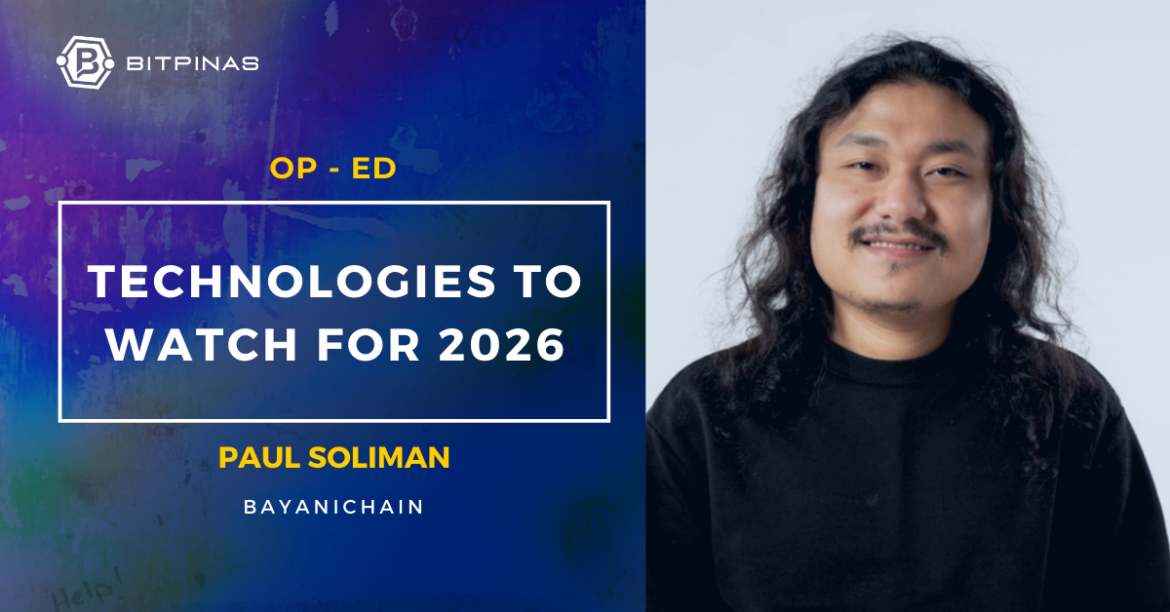
Paul Soliman is the Founder and CEO/CTO of Hacktiv Colab Inc. and Chairman and Group CEO of BayaniChain, where he leads initiatives in blockchain, enterprise tech, and digital nation-building. He also serves as CTO of Blockfy, driving innovation in decentralized finance solutions in the Philippines.
![Photo for the Article - [Op-Ed] Paul Soliman: Technologies to Watch For 2026](https://bitpinas.com/wp-content/uploads/2026/01/image-2.png "[Op-Ed] Paul Soliman: Technologies to Watch For 2026 2")
Privacy First Blockchain as the New Moat

By 2026, privacy emerges as a defining advantage in blockchain systems, alongside performance and scale. As these foundations mature, trust becomes the distinguishing factor, particularly in trustless environments where verification must exist without unnecessary exposure.
There is a gradual shift from broad transparency toward controlled verifiability. As blockchain platforms mature, enterprises and governments are increasingly focused on how proofs can be generated without unnecessary data exposure. Questions now center on validating integrity, enabling auditability, and preserving confidentiality at the same reminds rather than maximizing raw throughput alone.
Techniques such as privacy preserving computation, selective disclosure, encrypted state, and zero knowledge based proofs are becoming part of core system design. Even in ecosystems like Ethereum, privacy work at the protocol and application layers continues to evolve to support confidential transactions and verifiable computation. Platforms that treat privacy as foundational infrastructure, rather than an optional feature, are more likely to earn sustained trust. At this stage, blockchain becomes less about visibility and more about reliability.
Sovereign Cloud and the Shift of Data Gravity
Data is becoming geopolitical, and architecture is adjusting accordingly.
In the Philippines, there is a visible move toward sovereign cloud thinking. Sensitive data is increasingly expected to reside within national jurisdiction. Cloud strategies are being revisited around data residency, key ownership, and operational control. There are also early conversations around data embassies, where protection is enforced not only through encryption, but through jurisdictional guarantees.
This shift changes how systems are designed. Where validators operate. Where encryption keys are stored. Where AI models are trained. Blockchain increasingly serves as a neutral coordination layer that allows sovereignty without isolation, enabling interoperability while preserving control.
By 2026, cloud decisions are no longer purely technical or financial. They are strategic.
Real World Assets in the Philippines
Sandboxes Become Operational Pathways
What is emerging quietly in sandbox environments points to a shift from exploration to execution.
With the SEC opening the CASP framework and sandbox programs, many companies are now using these environments as practical pathways to test real world asset models. From what we are seeing and hearing, a significant number of applications focus on asset backed and investment oriented use cases such as property, energy, commodities, receivables, and infrastructure related instruments. These efforts are less about experimentation for its own sake and more about understanding how capital can move efficiently, transparently, and at scale.
In this context, tokenization moves beyond novelty and toward structure. Ownership becomes clearer. Fractional participation becomes more accessible. Auditability is built in rather than added later. Settlement becomes more predictable. For investors, these sandboxes offer early insight into how assets behave when placed on digital rails, including liquidity, governance, and operational risk.
By 2026, real world asset tokenization is expected to operate in live sandbox environments, allowing investment structures to be observed, refined, and understood before broader deployment.
Domain Specific Language Models and Multi Agent Systems
General intelligence continues to capture attention, but specialized intelligence delivers practical value.
There is growing demand for domain specific language models trained deeply on procurement, safety, law, finance, compliance, and operations. These models are no longer standalone tools. They operate within multi agent systems where one agent proposes, another verifies, another executes, and another audits.
Blockchain quietly becomes the trust fabric between these agents. Actions are logged. Decisions are traceable. Accountability is preserved even as automation scales.
By 2026, intelligence becomes modular, verifiable, and operational rather than purely conversational.
Quantum Computing Enters Through Practical Experiments
Quantum computing does not arrive through disruption. It arrives through caution.
Early use cases focus on encryption experiments, key generation, randomness, and post quantum cryptography validation. Governments and institutions are testing assumptions rather than replacing existing systems. The emphasis is on readiness, not immediacy.
Blockchain architectures that acknowledge quantum futures early are likely to age more gracefully. Preparing for quantum does not imply alarm. It reflects design humility.
By 2026, quantum awareness becomes part of broader technology planning rather than a separate conversation.
Small Language Models and Edge Intelligence
While large models dominate headlines, small language models are where adoption quietly accelerates.
Edge devices running compact models enable offline intelligence, privacy preserving inference, lower latency, and reduced cloud dependency. This matters in factories, vehicles, remote sites, and government field operations where connectivity is inconsistent and data sensitivity is high.
Blockchain anchors truth. Edge AI handles reasoning. The cloud becomes optional rather than mandatory.
By 2026, intelligence moves closer to where work and decisions actually happen.
Government Blockchain Across ASEAN
What began as pilots is gradually becoming policy across the region.
ASEAN governments are moving beyond experimentation toward production systems for document integrity, budget transparency, cross border verification, and digital public assets. The Philippines is part of a broader regional learning curve where patterns are shared, lessons are exchanged, and standards quietly take shape.
Blockchain increasingly functions as civic infrastructure rather than a press release.
By 2026, governance itself begins to feel more programmable, but also more accountable.
Closing Reflection
As 2026 approaches, the focus feels less about breakthroughs and more about responsibility.
Across projects, partners, and conversations, there is less urgency to be first and more intention to be correct. To design systems that respect privacy. To place data where it belongs. To automate without removing accountability. To adopt new technology without losing sight of public trust.
Many of these shifts are still unfolding. Some will move faster than expected. Others will require patience, regulation, and collective learning. No single company or country has all the answers.
The work ahead is steady, careful, and often unseen. And that may be exactly how meaningful infrastructure should be built.
Paul Soliman is the Founder and CEO/CTO of Hacktiv Colab Inc. and Chairman and Group CEO of BayaniChain, where he leads initiatives in blockchain, enterprise tech, and digital nation-building. He also serves as CTO of Blockfy, driving innovation in decentralized finance solutions in the Philippines.
This Op-Ed is published on BitPinas: [Op-Ed] Paul Soliman: Technologies to Watch For 2026
What else is happening in Crypto Philippines and beyond?
