Disclaimer: This article is for informational purposes only and does not constitute financial advice. BitPinas has no commercial relationship with any mentioned entity unless otherwise stated.
📬 Get the biggest crypto stories in the Philippines and Southeast Asia every week — subscribe to the BitPinas Newsletter.
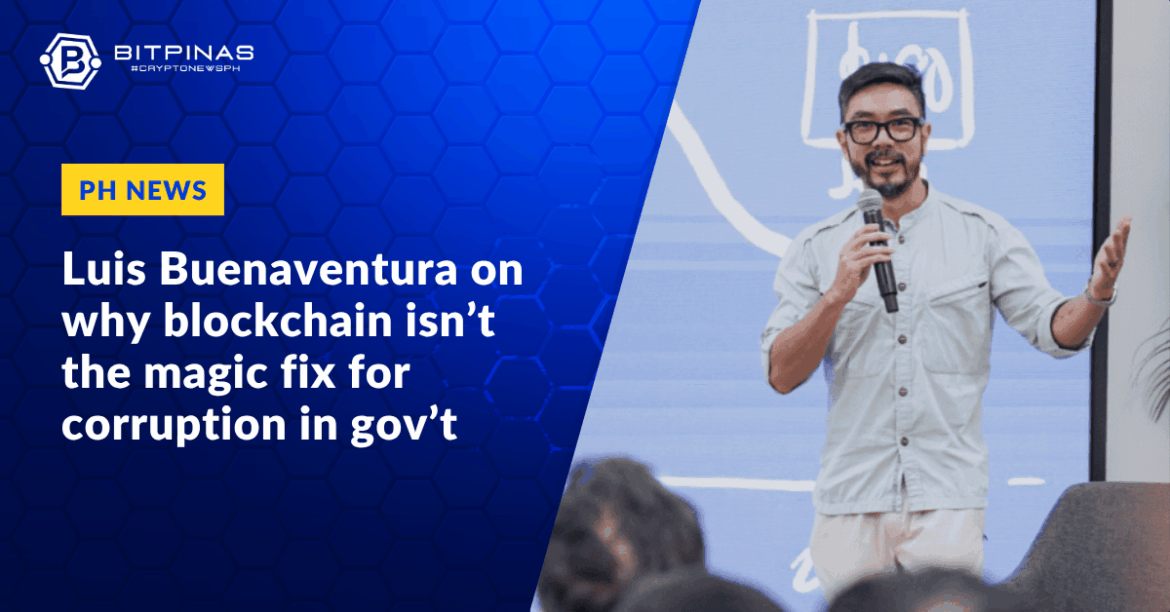
“Blockchain can’t prevent fraud within the Philippine government,” CryptoPH thought leader and GCash Vice President Luis Buenaventura said, arguing that even the global blockchain industry has failed to stop scams and misuse within its own systems.
Blockchain Can’t Prevent Fraud
In his latest Cryptoday column, Buenaventura pointed out the recent push to adopt blockchain for government transparency, arguing that the technology is fundamentally misunderstood.
“I’ll get right to the point: blockchain can’t prevent fraud within the Philippine government. The blockchain industry has never been able to prevent fraud within its own ranks, and there is no evidence that it could do so when applied at the scale of a national budget.“
Luis Buenaventura, Head of Crypto and Vice President, GCash
Buenaventura noted that over the last decade, the blockchain industry has experienced widespread fraud across multiple levels, from centralized platforms such as FTX, Celsius, and Mt. Gox, to smart contract-based schemes like Forsage, token-level scams including OneCoin and Bitconnect, and even at the blockchain level, as seen in Bitcoin Satoshi’s Vision.
He explained that while blockchain can help “combat” corruption by improving record transparency, it cannot “prevent” it entirely.

Buenaventura then clarified that blockchain is often misunderstood, noting that while the Bitcoin blockchain can serve as a “source of truth” for its own native token, it cannot verify external data like government documents due to the unresolved ‘data oracle’ problem.
“As soon as we start attempting to bring in data from the outside world (public documents, art, music, etc.), we run into the classic ‘data oracle’ problem. This problem means that although the blockchain can preserve data well, it can not verify the data it receives from outside and must therefore blindly trust a data oracle. We know that the data oracle problem has NOT been solved at scale.”
Luis Buenaventura, Head of Crypto and Vice President, GCash
He warned that applying blockchain systems to contexts like the Philippines’ $100-billion national budget would still face vulnerabilities due to unresolved issues like the data oracle problem.
Furthermore, Buenaventura concluded that while blockchain can create efficiencies, it is no more trustworthy than a regular database when reliant on external data sources.
Satirical ‘Solutions’ Show Tech’s Limits
To illustrate the flaws and extreme measures required for blockchain to force accountability truly, Buenaventura proposed several speculative and “silly” ideas, each with a critical flaw.
- NFTs for Documents: One proposal suggests minting every budget document as a one-of-one non-fungible token (NFT) and tying them to government departments as “soulbound tokens” for public monitoring.
- The Flaw: “The biggest problem with this idea? The fact that an NFT is simply a pointer to an external resource, so if you were clever enough to swap out the underlying binaries (a PDF, for example) then you could alter the document it was pointing to.”
- Staking Personal Assets: Another idea was to require high-ranking officials to convert and “stake” their personal assets in stablecoins for their term, making their finances radically transparent on public explorers.
- The Flaw: “You cannot guarantee that all of their personal assets were actually declared.”
- A National Stablecoin: The most “nuclear option” involved transitioning the entire Philippine economy to a peso-backed stablecoin, making all transactions traceable and freezable by the state. While this would make fraud traceable, Buenaventura warned it would create a dystopian system.
- The Flaw: “In case it’s not obvious, I’M NOT ADVOCATING FOR THIS IDEA… We would have to place our entire economy on top of a blockchain, and abdicate all control over our money to the very entity that we are finding so hard to trust.”
Opinions on Utilizing Blockchain in the Government
Buenaventura’s critique joins a growing discourse among experts as multiple government bodies — including the DPWH, DBM, DICT, and Baguio City — begin adopting blockchain systems, and with 11 related bills filed in Congress.
Skeptical Voices:
- Florin Hilbay: The former Solicitor General criticized the proposals as “costly and unnecessarily complex,” suggesting a public “National Budget in Action” website and open data access for journalists would be more effective.
- Dominic Ligot: The technologist and AI advocate argued the government should prioritize AI “to process and index public documents to make them searchable” for genuine accountability.
- John Clark Naldoza: The tech writer echoed Buenaventura’s core point, warning that blockchain “cannot verify the accuracy of information entered into the system.”
Proponents’ View:
- President Ferdinand “Bongbong” Marcos Jr.: Following controversies over “ghost” projects, the president said blockchain “could work” as a tool to monitor public funds. However, he also stressed that corruption persists mainly because “existing rules are not being followed.”
This article is published on BitPinas: Crypto Exec Luis Buenaventura: Why Blockchain Cannot Prevent Fraud in PH
What else is happening in Crypto Philippines and beyond?
