Cardano price continues to weaken as bearish market structure remains intact, with failed resistance retests and weak demand raising the risk of a deeper correction.
Summary
- Bearish market structure with consecutive lower highs intact.
- Loss of the Point of Control shifts the price to a lower value.
- Weak demand raises downside risk toward $0.27.
Cardano price (ADA) price action continues to reflect persistent bearish pressure, with market structure firmly tilted to the downside. Despite brief consolidation attempts, each rally has been capped by lower highs, reinforcing the broader downtrend.
Recent price behavior suggests that sellers remain in control, and without a meaningful shift in demand, Cardano risks extending its decline toward lower high-time-frame support levels.
Cardano price key technical points
- Lower highs continue to define Cardano’s downtrend
- Loss of the Point of Control shifts focus to lower value
- Weak reaction at the Value Area Low raises downside risk toward $0.27
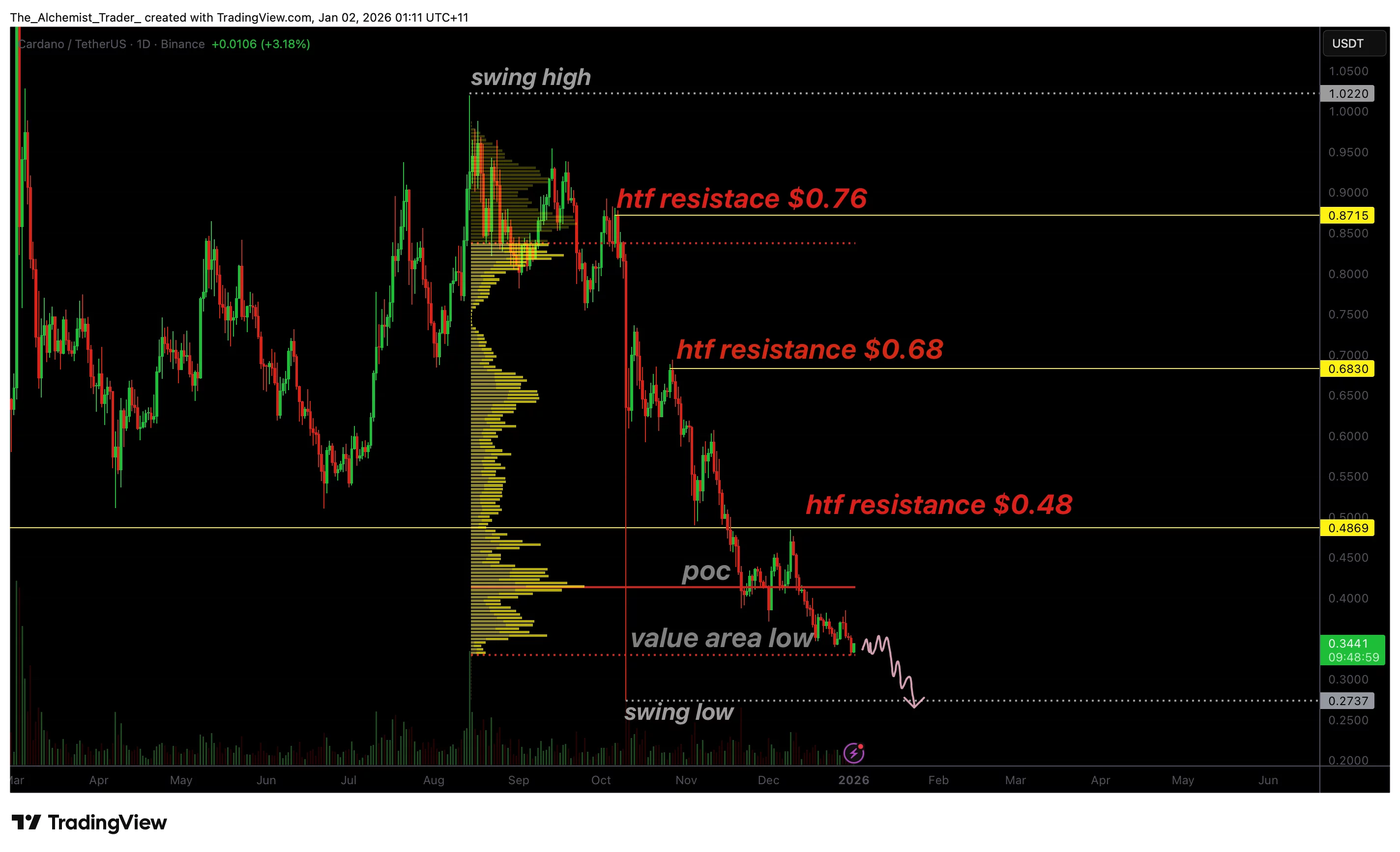
From a market-structure perspective, Cardano remains in a clear bearish trend, characterized by consecutive lower highs and lower lows. Each attempt to reclaim higher levels has failed, reinforcing the idea that upside moves are corrective rather than impulsive. This behavior is typical of markets where sellers maintain control and buyers lack conviction.
One of the most notable developments was Cardano’s rejection from the $0.48 high-time-frame resistance. After breaking below this level, price attempted a back-test, a common technical behavior that often determines whether a breakdown will hold. In this case, the back-test failed, and price was rejected, confirming $0.48 as a strong supply zone and validating the continuation of the downtrend.
Following this rejection, Cardano consolidated briefly around the Point of Control (POC). The POC represents the area of highest traded volume within the recent range and often acts as a pivot between bullish and bearish control. However, price has since lost acceptance above this level, signaling a transition away from balance and into lower value.
With the POC now acting as resistance, price has rotated toward the Value Area Low (VAL) of the broader trading range. This area typically attracts responsive buying, but the current reaction has been notably weak. The lack of strong bullish follow-through suggests that demand is limited, increasing the probability that support will fail rather than hold.
Weak reactions at the Value Area Low are often a warning sign. In stronger markets, price typically produces impulsive bounces from this region, supported by rising volume. In Cardano’s case, the absence of such behavior implies that buyers are either unwilling or unable to absorb selling pressure, leaving the door open for further downside.
From a price-action perspective, candles continue to reflect seller dominance, with upside attempts quickly sold into and downside momentum remaining intact. As long as Cardano continues to form lower highs beneath former support levels, the bearish structure remains valid.
Liquidity dynamics also favor continuation lower. Below the current price, there is relatively limited structural support until the swing low near $0.27, which represents the lower boundary of the larger trading range. Markets often gravitate toward such levels to clear resting liquidity, particularly when intermediate support zones fail to attract strong demand.
Importantly, a move toward $0.27 would not be unusual within the context of Cardano’s broader structure. Rather, it would represent a continuation of the prevailing trend, allowing the market to test deeper demand before any potential rebalancing occurs.
What to expect in the coming price action
As long as Cardano remains below the Point of Control and continues to print lower highs, downside risk remains elevated. A failure to produce a strong, high-volume bounce from the Value Area Low increases the likelihood of a rotation toward the $0.27 swing low.
Any bullish invalidation would require Cardano to reclaim the lost resistance levels and establish acceptance above the POC, a signal that has not yet appeared. Until then, the path of least resistance remains lower, with further downside likely in the immediate short term.
