Table of Contents
After seven years — a metric eternity in tech time — Sony has finally ventured back into the world of Bluetooth turntables. This spring, the company released the Sony PS-LX3BT ($399.99) and the Sony PS-LX5BT ($499.99), a pair of replacements for its original PS-LX310BT record player.
These newcomers have big shoes to fill. Long regarded as one of the best beginner-friendly turntables, the PS-LX310BT was a popular, perennial favorite for its easy setup, fully automatic operation, and minimalist look. It also helped that it was easy to find on sale for under $200 in its later years.
Admittedly, I never rode the PS-LX310BT hype train. The record player I’ve used for the past 10-odd years is an entry-level wired, manual turntable that’s served me well for the most part, save for some occasional needle issues. I like it a lot… or at least, I thought I did until I used the new PS-LX3BT for a month (the cheaper option). It made me feel so spoiled that I was genuinely bummed to ship it back at the end of my testing period. If you’re a vinyl novice in the market for a solid plug-and-play turntable, your search still ends with Sony.

$368
at Amazon
$398
Save $30
Sony PS-LX3BT review: Setup and hands on
The PS-LX3BT ships in a few parts and looks a little intimidating right out of the box, but assembly wound up being a cinch. You just pop on its aluminum platter, hook a rubber belt around its motor pulley, place a slip mat on top, and snap some hinges onto its plastic dust cover. (You can also use it without the cover.) Sony’s instructions are easy enough to follow, but there are plenty of setup tutorials on YouTube if you need extra guidance.

Here’s what the Sony PS-LX3BT looks like right out of the box.
Credit: Haley Henschel / Mashable
The PS-LX3BT is a belt-drive turntable, which means its motor is separate from its platter, the plate-shaped thing underneath your record. (They’re connected by the aforementioned belt.) This produces less vibration when the motor is running, preserving audio quality, though the belt can stretch out over time and may need to be replaced eventually. The other kind of turntable you’ll encounter is the direct-drive variety, which has a motor that’s attached to the platter. These are more durable and have more consistent speeds, but they can be noisy. Professional DJs generally prefer direct-drive turntables, but belt-driven ones, which tend to be cheaper, are fine for the rest of us.
I did notice that the PS-LX3BT made a mechanical whirrr sound when it was on, but it was impossible to hear once a record started playing. This will only bother the pickiest audiophiles.

The Sony PS-LX3BT’s main housing, or plinth, has a dark gray finish.
Credit: Haley Henschel / Mashable
The PS-LX3BT is stupidly simple to use. Hit the “Bluetooth” button on the left-hand side of its base, or plinth, to connect it to a wireless speaker, soundbar, or wireless headphones. An indicator light next to the button glows blue when it’s paired.
You can also hook up the PS-LX3BT to wired speakers if you’re really worried about latency or sound quality. (Bluetooth compresses audio for the trade-off of portability, which, to vinyl purists, defeats the point of listening to analog vinyl.) There’s an attached audio cable and a built-in phono preamp, so you just need to plug in your speakers of choice.

Two other buttons near the Sony PS-LX3BT’s Start button let you manually stop and raise or lower the tonearm as needed.
Credit: Haley Henschel / Mashable
Once the PS-LX3BT is connected to some kind of audio output device, you just have to press the green “Start” button on the opposite side of its plinth. Your record will start spinning, and the tonearm will automatically move over, drop down, and start playing it from the beginning. When it reaches the end of the record side, the tonearm rises and returns to its cradle. It makes some mechanical clacking noises along the way, which might bug some folks, but it’s great in that it’s completely fuss-free.
Mashable Light Speed
The PS-LX3BT supports standard 12-inch albums or 7-inch singles, and you can play either of them at 33 1/3 or 45 revolutions per minute (RPM). There are knobs that let you switch between the two sizes and speeds on the right-hand side of its plinth. Sony throws in an adapter for 7-inchers, which you can stash in a slot within the plinth.

You can rip vinyl records onto your laptop using the Sony PS-LX3BT’s USB-B port. Its power cable is removable (right), but its audio cable (left) is not.
Credit: Haley Henschel / Mashable composite
The PS-LX3BT’s rear connectivity includes a USB-B port that lets you rip vinyl tracks onto your laptop. I didn’t have a USB-B cable on hand when I was testing the turntable, so I couldn’t try it myself (it’s sold separately). But this is a cool feature that I would absolutely use to digitize physical-exclusive bonus tracks, B-sides, and vinyl releases that differ from the streaming versions. I can’t be the only one who misses the “Milkshake” sample on Beyoncé’s Renaissance.
For $100 more, the premium PS-LX5BT model nets you a detachable audio cable, a slightly thicker slip mat, and a gold-plated audio jack, which “supports a high-grade wired connection,” according to Sony. (From what I’ve read, it’s mainly a durability thing.) Its plinth is black, while the PS-LX3BT is more of a dark gray.

The Sony PS-LX3BT’s cartridge has a tracking force of 3.5 grams, which puts it on the heavy side.
Credit: Haley Henschel / Mashable
The pricier PS-LX5BT also has a lighter, removable cartridge (the part that houses the needle on the end of its tonearm). Its cartridge has a tracking force of two grams, while the cheaper PS-LX3BT’s cartridge has a tracking force of 3.5 grams. I think this is the biggest advantage of splurging on the PS-LX5BT: Lighter cartridges equal less wear and tear on your vinyl.
A tracking force of one to three grams is generally ideal, which makes the PS-LX3BT’s cartridge a bit heavy. It’s not adjustable, unfortunately, though you might be able to jerry-rig a counterweight yourself if you’re concerned about long-term vinyl damage. Someone on Reddit lightened the tracking force of their PS-LX310BT (Sony’s older turntable) by putting a kneaded eraser on the back end of its tonearm.
Sony PS-LX3BT vs. Sony PS-LX310BT: What’s new?

The original Sony PS-LX310BT (top) versus the newer Sony PS-LX3BT (bottom).
Credit: Haley Henschel / Mashable composite
My sister, who lives nearby, happens to own the original PS-LX310BT, so I stopped by her apartment to check it out. There are a couple of small differences between it and the newer PS-LX3BT, but overall, the latter is a pretty iterative update. (My colleagues have said similar things about Sony’s latest XM6 headphones and earbuds. That’s modern consumer tech for you.)
Here’s what sets them apart:
-
The PS-LX3BT adds support for AptX and AptX Adaptive Bluetooth codecs.
-
The PS-LX310BT’s Start, Stop, and Up/Down buttons are flush on the side of its plinth. The same buttons protrude on the surface of the PS-LX3BT.
-
The PS-LX310BT’s record speed and size dials are knobs on the PS-LX3BT.
-
The PS-LX310BT’s dust cover has a smoky gray tint. The PS-LX3BT’s cover is clear.
The PS-LX310BT retailed for $449.99 at launch, though it was often on sale for half that in recent years. I think it’s still worth buying if you can catch it at a very cheap price, but it’s getting tougher to find in stock nowadays.

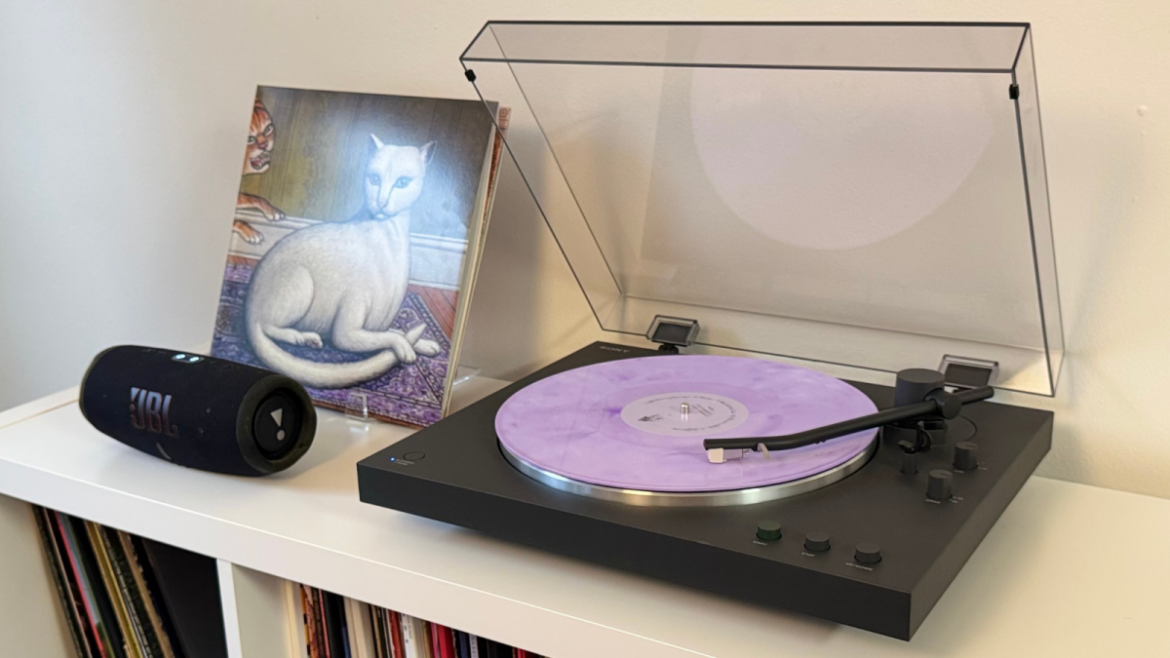
The Sony PS-LX3BT’s transparent dust cover lets you see colorful pressings clearly.
Credit: Haley Henschel / Mashable
If you already own the PS-LX310BT, there’s no world in which you’d need to upgrade to the PS-LX3BT. Its design tweaks are minimal, and its tonearm-moving mechanism is exactly the same. In theory, its AptX and AptX Adaptive support translates to better wireless audio quality, but the records I spun on my sister’s PS-LX310BT didn’t sound worse.
Sony PS-LX3BT review: Final thoughts

I’m a Sony convert if my current record player dies.
Credit: Haley Henschel / Mashable
The PS-LX3BT is a stylish turntable with idiotproof plug-and-play functionality. Its Bluetooth connectivity and automatic operation will turn off vinyl purists, but they’re boons for newbies.
As someone who came to the PS-LX3BT from a wired, manual record player, I can’t deny the appeal of this convenience — and if mine ever gives out, I’ll seriously consider defecting to Sony. I’m precious with my vinyl collection, so I’d go with the nicer PS-LX5BT model for the lighter cartridge.
The PS-LX3BT and PS-LX5BT are both expensive compared to other top-rated turntables, so try to buy them on sale. (I think you’re mostly paying a premium for the Sony name, though I’m inclined to trust its build quality over other random brands you might find at Best Buy or Amazon.) At the time of writing, both models were up to $30 off at major retailers.
$368
at Amazon
$398
Save $30

$473
at Amazon
$499.99
Save $26.99
