Disclaimer: This article is for informational purposes only and does not constitute financial advice. BitPinas has no commercial relationship with any mentioned entity unless otherwise stated.
📬 Get the biggest crypto stories in the Philippines and Southeast Asia every week — subscribe to the BitPinas Newsletter.
Interview by Michael Lance Domagas
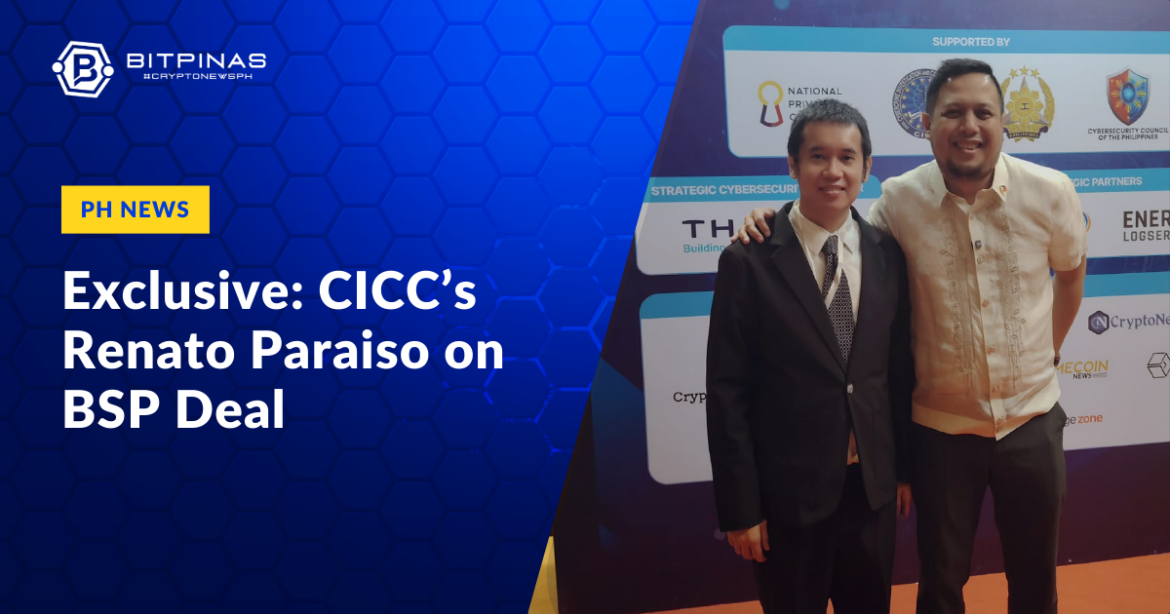
Following the signing of a landmark data-sharing agreement between the Bangko Sentral ng Pilipinas (BSP) and law enforcement agencies, a top official from the Cybercrime Investigation and Coordinating Center (CICC) has clarified the operational power of the new deal: the ability to bypass lengthy court proceedings to obtain financial data.
In an interview, CICC Executive Director Renato “Aboy” Paraiso confirmed that the agreement activates the “administrative subpoena” powers under the Anti-Financial Account Scamming Act (AFASA).
No More Court Orders for Bank Data
Paraiso explained that the new mechanism fundamentally changes how investigators generate leads. Previously, obtaining bank records required applying for a court order and proving the “necessity” of the request in a hearing — a process that often delayed investigations.
“It is a data-sharing agreement that would grant us the capability to subpoena documents from the banking sector based on the AFASA Law,” Paraiso stated. “Hindi na ho tayo dadaan ng korte (We will no longer go through the courts). It’s an administrative subpoena.”
Under the new workflow, agencies like the CICC and the National Bureau of Investigation (NBI) will provide “actionable leads” to the central bank.
“We would request the BSP to issue the subpoena for us to investigate these types of cybercrimes,” Paraiso said, noting that the BSP can issue the order “kaagad-agad” (immediately) based on the enforcement agency’s request.
GCash and Maya Covered; Blockchain ‘Different’
When asked about the scope of these subpoenas, Paraiso explicitly confirmed that they cover traditional financial institutions and electronic wallets.
“Kasama dito yung mga wallet — GCash, Maya — exactly,” he noted.
However, the CICC chief drew a distinct line when asked if the same “administrative subpoena” power applies to blockchain-based entities.
“Blockchain is different naman eh. So it’s not covered under the [AFASA],” Paraiso said during the interview. “Iba ‘to (This is different).”
While the AFASA law generally includes Virtual Asset Service Providers (VASPs) under its supervision, Paraiso’s comments suggest that the specific administrative subpoena mechanism for immediate data access may currently be focused on the traditional banking and e-wallet sectors.
‘Nowhere to Hide’
The CICC Executive Director emphasized that the primary goal of the agreement is speed and efficiency in tracking down financial criminals.
“Dahil administrative siya, mas mabilis siya (Because it is administrative, it is faster),” Paraiso said.
He concluded with a warning to criminals utilizing the country’s financial rails: “Wala na. Hindi na kayo makakapagtago. (It’s over. You can no longer hide).”
This development follows the BSP’s signing of the agreement with the NBI, CICC, and Securities and Exchange Commission (SEC) on February 25, 2026, aimed at strengthening the enforcement of Republic Act No. 12010.
This article is published on BitPinas: Exclusive: CICC’s Renato Paraiso Says BSP Deal Allows Bank Data Access Without Court Orders
What else is happening in Crypto Philippines and beyond?
