Disclaimer: This article is for informational purposes only and does not constitute financial advice. BitPinas has no commercial relationship with any mentioned entity unless otherwise stated.
📬 Get the biggest crypto stories in the Philippines and Southeast Asia every week — subscribe to the BitPinas Newsletter.
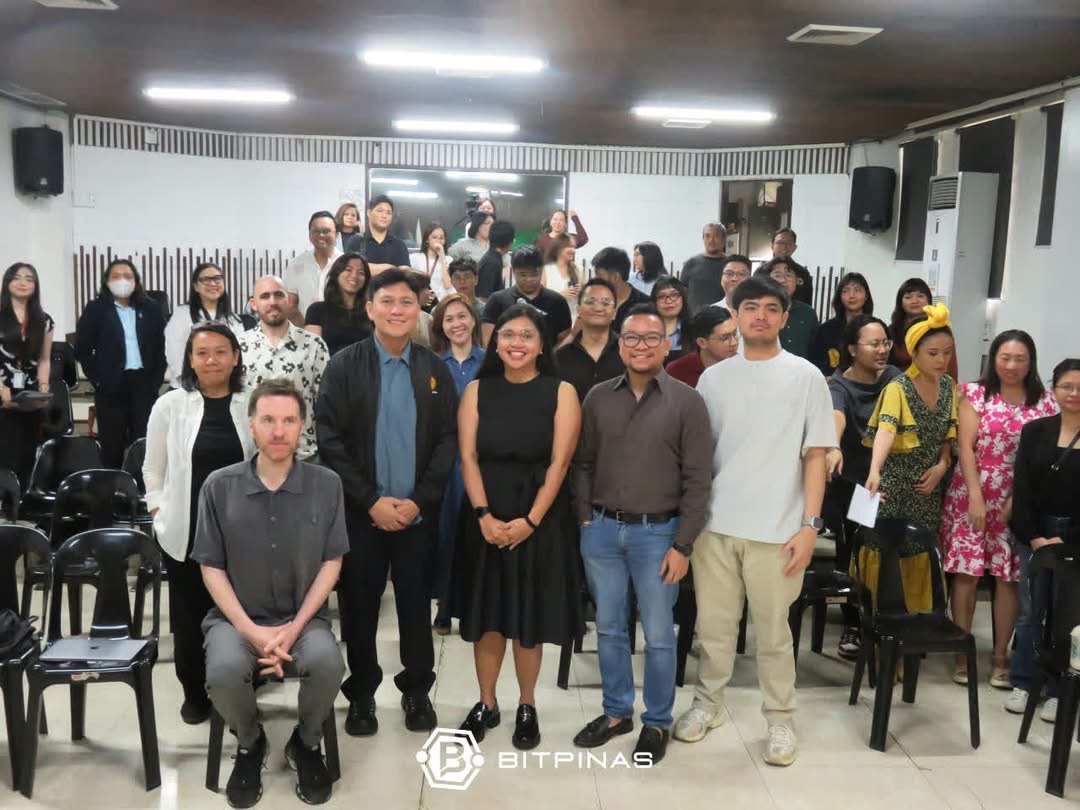
The Department of Communication Research of the University of the Philippines (UP) College of Media and Communication hosted a research symposium that discussed cryptocurrency’s role in Philippine society through ethnographic and empirical investigations.
This is the recap of the research symposium, which had four discussions and an open forum from researchers from UP Diliman and Denmark’s Aarhus University. BitPinas attended the event.
The Social Life of Crypto: Philippine Perspectives

Why The Philippines as Research Subject About Crypto
Presented by Steffen Kohn, Ph.D., an assistant professor at Aarhus University’s Department of Anthropology, this research looks into actual use cases of crypto in three field sites: Cuba, the Philippines, and Kenya.
According to Kohn, these three countries have challenges in financial inclusion. And crypto has been adopted as a “pragmatic tool.”
The researcher then emphasized that BTC is an anti-establishment libertarian idea, as it seeks to bank the unbanked. And out of the 70% of the total population of the Philippines who are unbanked, around 20% already have crypto wallets.
He cited Boracay, where multiple establishments are already accepting BTC as payment. Check out this list of articles from BitPinas about Boracay turning into “Bitcoin Island.”
Moreover, Kohn explained that the Philippines was chosen as a field site of their research because the country’s domestic growth is heavily dependent on remittances. In fact, BitPinas has already reported multiple companies that are utilizing stablecoins, which are cryptocurrencies whose value is pegged to another asset like PHP, for faster yet cheaper remittance.
Lastly, the researcher shared that another factor that made the Philippines a field site is that in 2021, during the popularity of the play-to-earn game Axie Infinity, many were onboarded into the crypto industry.
There will be 10 to 15 key research sites in the Philippines, each in the Metro Manila and Bicol Region.
Speaking from a broader perspective, Khon highlighted that crypto is now transitioning from anarchism to pro-regulation pragmatism.
“Crypto started as an anti-state ideology, and now, the president of the United States and the president of Argentina have issued their own meme coins.”
Steffen Kohn, Ph.D., Researcher, The Social Life of Crypto: Philippine Perspectives
Cryptocurrency Adoption in the Philippines: Social Networks, Informal Economies, and Relational Logics
In this presentation, Jonalou Labor, Ph.D., a professor at UP Diliman and a postdoctoral research fellow at Aarhus University, discussed ethnographic findings on how local communities from the Philippines pushed for crypto adoption through pakikipag-kapwa.
“Entry happens through existing friendships. There were no credentials needed. The infrastructure is relational before it is technical.”
Jonalou Labor, Ph.D., Professor at UP Diliman and Postdoctoral Research Fellow at Aarhus University
Labor then cited a 34-year-old Axie Infinity player from Caloocan City, who became a scholar of his friend before becoming a manager of his own guild. For the researcher, this shows an opportunity that someone was able to earn a living by just connections—no interviews, no credentials, no corporate processes.
“This is crypto adoption. THROUGH Filipino things.
“Nobody said, ‘I am doing pakikipagkapwa to earn in crypto.’ But we have the same social practices.”
Jonalou Labor, Ph.D., Professor at UP Diliman and Postdoctoral Research Fellow at Aarhus University
Bicol as Emerging Blockchain Hub
In addition, Labor also presented the case of SparkPoint CEO Ismael Jerusalem and CTO Harvey Javier. A story where the two builders just met in Bicol and talked about Bitcoin, and now, they are offering bootcamps and trainings for those who want to be blockchain developers.

Bicol is highlighted in this research due to its active crypto community. Labor presented that from less than 10 people that knew about the technology in 2019, the Bicol Blockchain Community was able to have university partners and a conference in a cinema in a mall in Legaspi City, Albay. But the biggest highlight of its community, according to the researcher, is its partnership with the regional government agencies.
This includes:
- Department of Trade and Industry as co-host of the conference.
- Department of Information and Communication Technology for ecosystem participation.
- Department of Science and Technology-Technology Business Incubation for incubating blockchain-based projects.
- SILI DELI, the first technology business incubator in the Bicol Region and funded by the Department of Science and Technology, for hosting the event.
This is where Labor discussed that unlike in Metro Manila, where there was “benign neglect” from the regulators, the active participation from government agencies in the Bicol Region is one of the reasons why it has a growing crypto community.
“It’s relationship building, not regulation, that creates innovation.
Communities do not need regulation; they need enough ambiguity to build infrastructure through relationships rather than migrating for formal authorization.”
Jonalou Labor, Ph.D., Professor at UP Diliman and Postdoctoral Research Fellow at Aarhus University
In this study, Labor was joined by Randy Jay Solis, Ph. D., and Christian Samonte, M.A., both from UP Diliman.

The research showd that because of high mobile penetration in the Philippines, where 95% of Filipinos have their own mobile phones, there is also a high rate of adoption.
Meanwhile, the crypto industry in the Philippines is described in the research as a “sophisticated multiplatform ecosystem.” It is because there is a diverse range of “crypto actors,” like traders, community moderators, and others. An individual having multiple roles is also a common practice.
In terms of devices used, data from the research found that 94% are using their mobile phones to monitor the crypto market, while 75% of respondents said they are using their laptop for complex market analysis and multiple workflows.
Blockchain for Governance and Investment
For this discussion, Atty. Ma. Andreah Celes, a student member of the Chartered Institute of Arbitrators, presented an analysis of the CADENA Act and the rule on Crypto Asset Service Provider (CASP) by the Securities and Exchange Commission.

Celes cited the English Law, which mandates that BTC, or crypto in general, is considered property. Thus, regulation should cover it and be regulated.
Why SEC’s CASP Rules are Necessary
But regulation should not be treated as an enemy. as the lawyer explained that the CASP Rules will protect crypto owners whenever there are frauds that happen.
An example she gave is with the FTX collapse, where whenever a user experiences a problem similar to this, CASP can protect them.
“The law may be a partner to crypto asset holders when we need to protect and enforce our property rights.”
Atty. Ma. Andreah Celes, Presenter, Blockchain for Governance and Investment
Lastly, Celes explained that frauds happen not because of the nature of crypto industry, but because it is human nature.
“You really can’t stop people from making something bad. It is a human defect. Fraud is a product of human defect.”
Atty. Ma. Andreah Celes, Presenter, Blockchain for Governance and Investment
She also admitted that the problem with regulation is that it is always behind for every initiative, calling it “always miles away.” Thus, whenever a new initiative exists, frauds happen first.
This article is published on BitPinas: UP Symposium: How Filipino Culture and Relationships Drive Crypto Adoption
What else is happening in Crypto Philippines and beyond?
