Disclaimer: This article is for informational purposes only and does not constitute financial advice. BitPinas has no commercial relationship with any mentioned entity unless otherwise stated.
📬 Get the biggest crypto stories in the Philippines and Southeast Asia every week — subscribe to the BitPinas Newsletter.
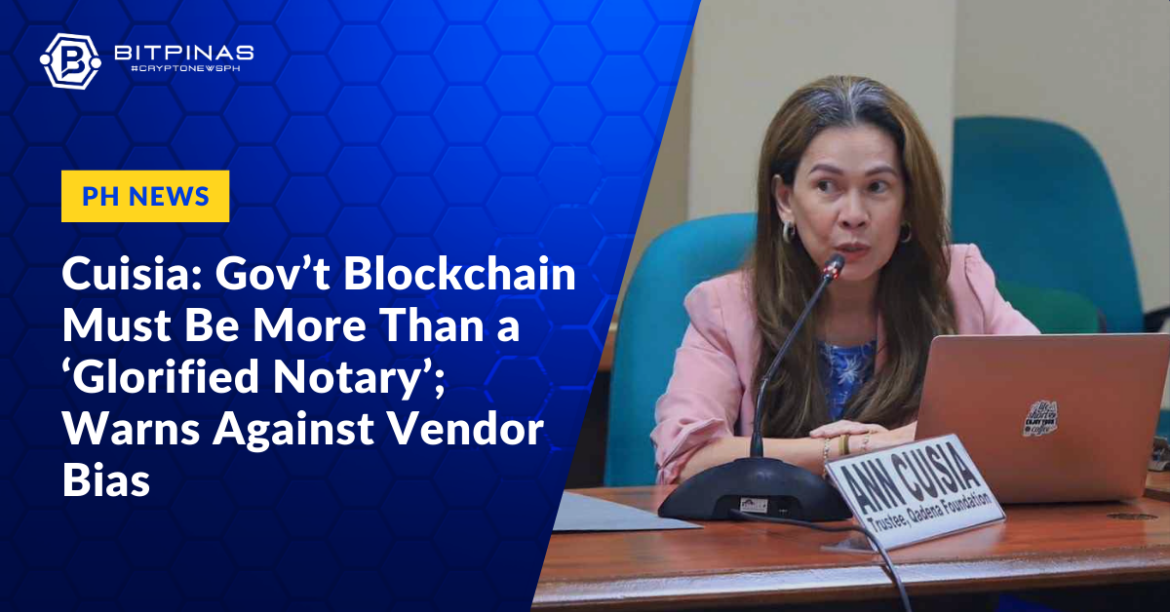
Qadena Foundation Trustee Ann Cuisia has responded to local provider BayaniChain’s recent defense of its government’s blockchain-based budget system, arguing that using the technology merely to prove a document exists reduces it to a “glorified notary system.”
In a statement sent to BitPinas on January 23, Cuisia emphasized that true transparency requires tracking the flow of public funds – – where the money actually goes – – not just stamping the paperwork after it’s been signed.
Ann Cuisia’s full reply is available at the end of the article.
Cuisia: Documentation is Not Transparency
Cuisia’s rebuttal directly addressed BayaniChain’s explanation that the “Digital Bayanihan Chain” acts as a public reference to verify official records. She contended that while this proves a document hasn’t been changed (provenance), it fails to stop the corruption that happens before the document is created:
“Using advanced technology just to prove a document existed is like hiring a forensic team to confirm that a receipt was printed. It does nothing to answer the harder questions: who inserted what, who got paid with what… and so on.”
She warned that if blockchain is used only for this limited purpose, it becomes an “expensive stamp” that wastes time, money, and public trust:
“Its real value is when it functions like a ledger, where entries are visible… and the flow itself is accountable. Where delays stand out. Where omissions are obvious.”
The Danger of Vendor Bias
Cuisia also criticized the habit of finding a problem to fit an existing product, a practice she labeled as “vendor bias.”
She referenced fellow technologist Jason Torres, who warned against compromising government needs just because a solution is offered for free or comes from a specific company.
“We cannot sacrifice features that we need just to accommodate a vendor or because it’s free,” Cuisia quoted Torres as saying.
Critical Context: The Debate on How to Blockchain the Budget
The debate stems from the Department of Information and Communications Technology’s (DICT) launch of the “Digital Bayanihan Chain,” a project intended to create a “digital seal of truth” for the national budget.
- The Criticism: Experts like Cuisia voiced concerns regarding the “no-cost” national project that is funded by a grant from a private group (Polygon). Among the issues raised is that it could trap the government into using one specific company’s technology forever (vendor lock-in) and question if the Philippines truly owns its data if it sits on a global, public network (digital sovereignty).
- The Defense: BayaniChain defends the system, saying a public network is necessary so no single person – not even the government – can tamper with the records. However, they nor the DICT have disclosed the full terms of the grant from Polygon.
Call For Honest Solutions
Cuisia concluded by urging the government to prioritize the country’s actual problems over shiny new tools.
“When a technologist already has a product and then looks for a problem it can fit into… that is not public service,” she wrote. “Accountability is not created by technology alone. It is created by honesty in how technology is applied”.
Full Statement from Ann Cuisia
Technology should always start with the problem, not the tool.
The real problem in government is not proving that a document exists.
The problem is governance, accountability and how public money moves, gets delayed, gets changed, or quietly disappears.
If the problem is governance, then the solution must watch the process, not just stamp the paperwork after the fact.
That’s where many discussions go off track.
Using advanced technology just to prove a document existed is like hiring a forensic team to confirm that a receipt was printed. It does nothing to answer the harder questions: who inserted what, who got paid with what, who is the unique beneficial owner of several bidders, and so on.
A system that only proves existence is not transparency.
It’s DOCUMENTATION.
Blockchain should not become a glorified NOTARY SYSYEM.
If it is used only for provenance, then it is an expensive stamp. A waste of time, money, and public trust.
Its real value is when it functions like a ledger, where entries are visible, changes are traceable, and the flow itself is accountable. Where delays stand out. Where omissions are obvious. Where patterns can be questioned.
That’s the difference between protecting paper and protecting people.
And finally, this is where responsibility comes in.
When a technologist already has a product and then looks for a problem it can fit into, without being fully honest about what problem it does not solve, that is not public service. That is vendor bias.
As my tech friend Jason Torres also said “Vendor bias create limitations. We cannot sacrifice features that we need just to accommodate a vendor or because it’s free. The right vendor and the right blockchain technology should be used for what the government really needs.”
“If the blockchain can’t store data, then it’s not the right blockchain to solve real accountability.”, he added.
True patriot technologists do the opposite. They start with the country’s pain points. They tell uncomfortable truths. They say clearly when a tool helps and when it doesn’t.
Only then do they design or choose a tool, blockchain or otherwise, to solve the real problem. Not to force-fit an existing product. Not to create the illusion that a certain problem exists simply so a specific solution can be sold.
Because accountability is not created by technology alone.
It is created by honesty in how technology is applied.
And that is what citizens should demand.
That is what tech movements, councils and academe should contribute — a clear pathway to solve this damn corruption without vendor bias, just the right tool for the actual problem.
-AJC, 012326
This article is published on BitPinas: Cuisia: Gov’t Blockchain Must Be More Than a ‘Glorified Notary’; Warns Against Vendor Bias
What else is happening in Crypto Philippines and beyond?
